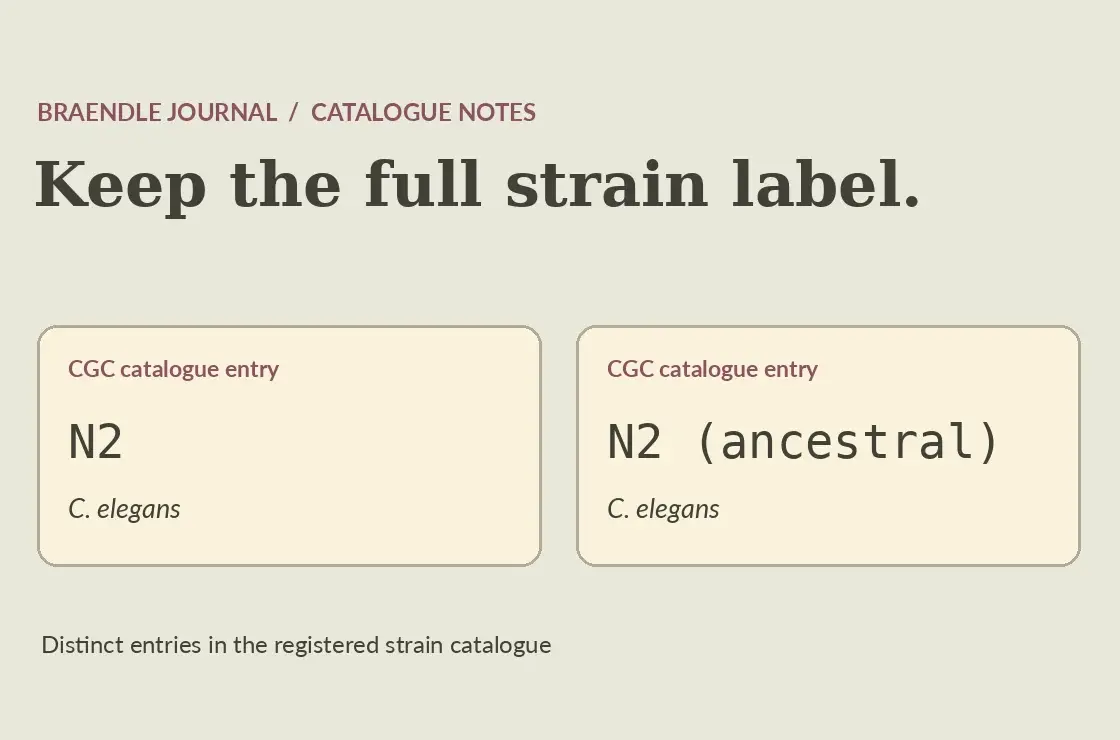
A short strain label is easier to understand when it sits next to the catalogue entry and the way the authors describe their material. Keep the name exactly as it appears in each source, including any qualifiers.
Start with a visible difference in the catalogue
The Caenorhabditis Genetics Center’s registered list contains entries labelled N2 and N2 (ancestral), both listed under C. elegans. The entries have distinct labels and descriptions. Even when two rows begin with the same short name, record which row you actually consulted. The comparison starts with the catalogue evidence; the paper still has to identify the material used in the study. CGC list of registered strains beginning with N.
Bring the catalogue and the paper together carefully
Write out the name in the paper exactly as printed. Look in the methods, acknowledgements or supplementary information for a repository, a fuller identifier or a description. Keep the source labels visible in your notes if the paper shortens a name in figures. A figure label can remain readable while the fuller reference lets a reader locate the material.
In a fictional reading exercise, article A says it used “Example 12” from an identified collection. Article B shows “E12” in a graph and gives a lab reference elsewhere. You can preserve both strings and write down the places where they occur. If a public record links the two references, add the evidence. Where the link is unclear, leave them as two records for the purpose of the comparison.
Use a compact reference field
For your own notes, record the paper, its exact strain label, the named collection and where the identifier appears. Add the catalogue link and date you consulted it. If a claim relies on an equivalence between entries, note the source that actually establishes that equivalence. The CGC strain-information page offers a starting point for navigating its records and associated naming information. CGC strain information.
This is a small archival habit with a practical result: a reader can return to the same evidence from a shortened figure label without carrying a catalogue assumption into a biological conclusion.